


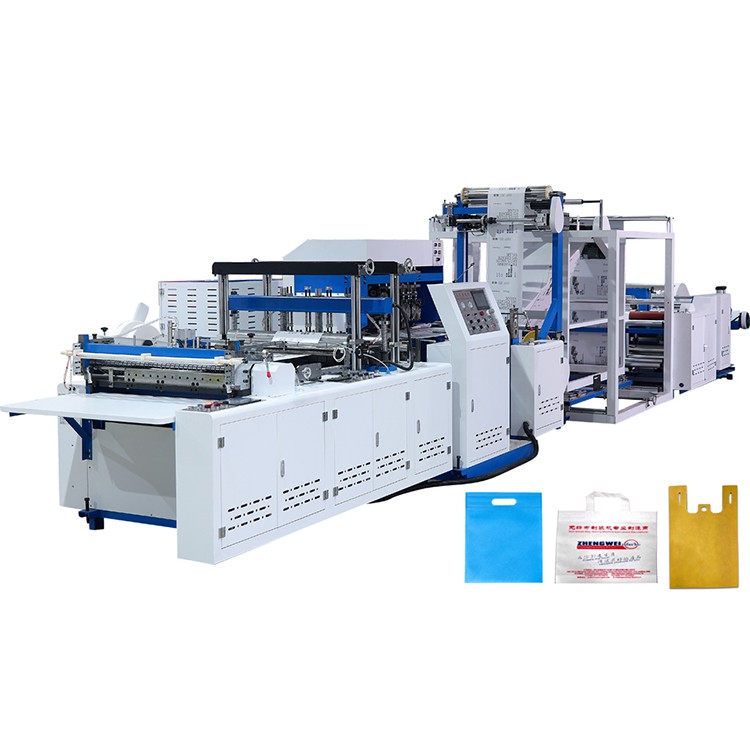
B700 Non Woven Bag Making Machine
In 2012, the company launched the world's first non-woven box bag making machine; In 2016, the project pp 3D bag making machine research and development was successful in 2022, and successfully developed plastic 3D bag making machine in 2017; In 2023, a new structured paper square bottom bag making machine was launched, After completing the independent research and development of the four major 3D bag production equipment, we have become a professional manufacturer of packaging 3D bag mechanical equipment. The product is widely used in four major shopping bags and various product packaging bags.
Why Choose Us
Our Factory
Zhejiang Zhengwei Machinery Co., Ltd. was established in 2007 and located in the south Zhejiang coast, the East China Sealt. It is a famous Chinese machinery manufacturing city - Ruian City, Zhejiang Province.
R&D
The company adheres to the design concept of high efficiency and environmental protection, with the mission of reducing white pollution, and is committed to the research and development, production, manufacturing, sales, and service of equipment such as non-woven box bags, plastic 3D bags, new structure paper square bottom bags, and pp 3D bags. In long-term practice, the company has gradually formed a business philosophy with independent research and development, design and manufacturing capabilities as its positioning. So far, the company has more than 100 invention patents and new utility and appearance patents.
Rich Experience
In 2012, the company launched the world's first non-woven box bag making machine; In 2016, the project pp 3D bag making machine research and development was successful in 2022, and successfully developed plastic 3D bag making machine in 2017; In 2023, a new structured paper square bottom bag making machine was launched, After completing the independent research and development of the four major 3D bag production equipment, we have become a professional manufacturer of packaging 3D bag mechanical equipment.
Our Service
The company adheres to the service tenet of "ZWE offer the best service to win the trust of customers", and strives to create a new era in the 3D bag industry. Focusing on the future, consistently, based on innovation, and strives to create a new era in the three-dimensional bag industry.

Non Woven Bag Handle Sealing Machine
Model:ZW-FM600
Material: Non-woven/PP
Material Thickness:30-100g
Production Speed:30-100pcs/min
Max. Bag Length:850mm
Max. Bag Height:580mm
Model:ZW-FM600
Material:Non-woven/PP
Material Thickness:30-100g
Production Speed:30-100pcs/min
Max. Bag Length:850mm
Max. Bag Height:580mm

Cloth Carry Bag Making Machine
Model:ZW-FM600
Material:nonwovensNon-woven/PP
Material Thickness:30-100g
Production Speed:30-100pcs/min
Max. Bag Length:850mm
Max. Bag Height:580mm

W Cut Non Woven Bag Making Machine
Model:ZW-FMF600
Material:Non-woven/PP
Material Thickness:35-120g
Production Speed:30-120pcs/min
Max. Bag Length:1000mm
Max. Bag Height:580mm

Non Woven Bag Handle Punching Machine
Model:ZW-FMF600
Material:Non-woven/PP
Material Thickness:35-120g
Production Speed:30-120pcs/min
Max. Bag Length:1000mm
Max. Bag Height:580mm

Model:ZW-FMF600
Material:Non-woven/PP
Material Thickness:35-120g
Production Speed:30-120pcs/min
Max. Bag Length:1000mm
Max. Bag Height:580mm

Automatic Carry Bag Making Machine
Model:ZW-FMF600
Material:Non-woven/PP
Material Thickness:35-120g
Production Speed:30-120pcs/min
Gas Source:0.8㎡/min 1.0mpa
Total Power:15kW

Non Woven Bag Manufacturing Unit
Model:ZW-A9
Material:Non-woven(laminating)
Material Thickness;80-140g
Production Speed:40-60pcs/min
Bag Width:200-460mm
Bag Gusset:70-200mm

Non Woven Bag Making And Printing Machine
Model:ZW-A9
Material:Non-woven(laminating)
Material Thickness:80-140g
Production Speed:40-60pcs/min
Bag Width:200-460mm
Bag Gusset:70-200mm
Non woven bag making machine with step-by-step fixed length, photoelectric tracking, accurate and stable. Automatic counting can set counting alarm, automatic drilling and other industrial control devices, so that the finished products are firmly sealed and beautiful tangent. High efficiency, is the high-quality environmental protection bag-making equipment you can rest assured of using.According to machine structure and operation form, it can be divided into single machine and automatic production line. Single machine has the advantages of low price, convenient use and simple maintenance. Multiple assemblies can be made to form a production line.
Advantages of B700 Non Woven Bag Making Machine
Automation and Efficiency
Non-woven bag machines are marvels of automation, churning out bags with minimal human intervention. They ensure high production rates, making them a favorite among manufacturers.
Touch-Screen Operation and User-Friendly Interface
Equipped with touch-screens, these machines boast an intuitive interface. Users can operate them with ease, making the process as simple as using a smartphone.
Robust Construction for Industrial Use
Built to last, non-woven bag making machines are constructed with heavy-duty materials. They're designed to withstand the rigors of daily industrial use without compromising performance.
Versatility in Bag Design and Size
These machines aren't one-trick ponies; they offer versatility in design and size. Manufacturers can produce a variety of bags tailored to different needs and preferences.
Technology for the Production of Non Woven Bag Making Machine
Spunlace of non-woven bag making machine: It sprays micro-water under high pressure into one or more layers of fiber mesh, so that the fibers are intertwined, so that the fiber mesh can be strengthened and have a certain strength.
Hot-bonded non-woven bag non-woven bag making machine: Refers to the addition of fibrous or powdery hot-bonding reinforcing material to the fiber network, which is then strengthened into a fabric by heating, melting and cooling.
Pulp air-net non-woven bag: Also known as dust-free paper, non-woven fabric for dry process papermaking. It uses air flow mesh technology to loosen the wood pulp fiber into a single fiber state and then uses the air flow method to agglomerate the fibers on the screen curtain and then reinforce the fiber mesh into a fabric.
Wet non-woven bag: It is designed to loosen the fiber material in the water medium into a single fiber, and at the same time mix different fiber materials to make a fiber suspension. The slurry is transported to the mesh mechanism and the fibers are woven into a mesh and consolidated into a fabric in the wet state.
Spunbond nonwoven bag: After the polymer is extruded and stretched to form continuous filaments, the filaments are placed into webs, which are then self-bonded, thermally bonded, chemically bonded, or mechanically strengthened to make the webs nonwoven.
Melt-blown non-woven bag:Its technological process: polymer feeding, melt, extrusion, fiber formation, fiber cooling, web reinforcement into fabric.
Acupuncture non-woven fabric making machine: It is a kind of dry non-woven cloth. Acupuncture non-woven fabric uses the needle piercing function to reinforce the fluffy network of fibers in fabric.
Sewing machine for making non-woven bags: It is a type of dry non-woven fabric. The sewing method is to reinforce fiber cloth, yarn layer, non-woven material (such as plastic sheet, plastic thin metal film, etc.) or their combination by using a coil structure to knit the base to make a non-woven fabric .
How to Choose Non Woven Bag Making Machines


Choose the machine from the bags
Before discussing what machines are needed, you need to have some basic understanding from the point of view for the non-woven bags you want to produce. This can also be helpful if you need to purchase non-woven bags.
Classification of bag types
Regarding the bag types of the non-woven bag, there are with different names in different countries and regions, and the classification can be based on the usage, such as shoe bags, nursery bags, garment bags, promotional bags, etc.; if discussing the models and specifications of the corresponding bag making machine, it is recommended to classify according to the appearance of the bags. The following five types of bags are the most common on the market, and thye are the first to know when purchasing a machine:
W-cut bag (t-shirt or u-cut, or vest bag)
The most popular type of polythene bags, instead of polythene, here it's made of polypropylene non woven fabric. Simple and practical, low cost, it is the most commonly used bag type in the banned country as well.
D-cut bag(or flat bag)
The same very common bag type is often used as a supplement to w-cut. In the banned countries, these two types of bags are conservatively estimated to account for more than 80% of the entire market.
Drawstring bag(shoes bag)
Usually used for the internal packaging of shoes, so it is also called shoes bag.
Handle bag(loop handle bag)
In fact, all bags with handles including the handle box bag below(no.5) can be called handle bags. But practically we call it "handle bag" only when it's not handle box bag.
Handle box bag
A handle bag with both bottom and side gusset, we call it handle box bag.
Materials
Non-woven bag making machines can handle a variety of materials, the most common of which is: Spunbond non-wovens . We are only discussing the spunbond non-wovens here, such as the water-spun non-wovens, which require a custom-made bag making machine.
Thickness
The unit of measure is gsm(grams per square meter), which is how many grams per square meter. The range of fabric thickness affects the choice of machine.
The theoretically producible fabric thickness range for most machines on the market is the same 30-120 gsm, but the "comfort range" varies from different configurations. A common configuration is 300mm ultrasonic with a comfort range of 50-120gsm.Only the fabric needs to use most of the time is more than 80gsm, 300mm ultrasonic is recommended. If you produce thinner fabrics most of the time, you can choose 153mm ultrasonic mould, the comfort range is about 20-50gsm.
Ii. Choose the bag making machine
Bag type corresponding bag making machine
Bag type corresponding machine capacity
And here is the corresponding capacity to those schemes.
[1] The machine can only produce one bag type at the same time. For capacity calculation and its influencing factors, check here.
[2] A single machine can match multiple manual punches, and 0.8 is a capacity for configuring a manual punch, if 2sets, 1.6million pcs.
[3] A single machine can match multiple hanlde sealing machines, and 0.3 is the capacity when configuring a single 4-point sealing, if 2sets, 0.6million pcs.
Iii. Other auxiliary machines
In the process of producing bags, other machines are needed to assist in the production of bag making machines:
Air compressor (required)
Necessary air source, select the corresponding power according to the number of models and machines.
Air compressors are divided into piston and screw, which are mainly reflected in the difference between the purchase cost and the use cost. The screw type is expensive, but durable and energy efficient.
Manual bag making machine (recommended)
There are two kinds of lace machines and spot welders, which are corresponding to edge welding and handle welding. Usually used in the following two situations:
Slitting machine (optional)
Fabric suppliers have a long supply and shipping cycle. In the face of changes in order specifications, or when the handle reel needs to be made by yourself, a slitting machine is required.
Stabilizer (optional)
In some countries, the voltage supply is unstable. It is recommended to purchase a voltage regulator to protect the stable operation of the machine.
The regulator is normally depleted. A general regulator, in an environment where the voltage change is not stable, it may take a 1-2 year to replace it.
Generator (optional)
Considering that the construction of grid facilities in individual countries is not perfect, or the power supply is insufficient, it will face more frequent power outages. In order to guarantee orderly production, temporary power supply can be provided by the generator.
Safety Measures for Non Woven Bag Making Machine
Training and Education
Operators should receive comprehensive training on how to use the specific machine they will be working with. Training should cover machine setup, operation, maintenance, and emergency procedures. It is essential to ensure that all operators are fully aware of potential hazards and how to mitigate them.
Read the Operator's Manual
Each bag making machine comes with an operator's manual provided by the manufacturer. Operators must thoroughly read and understand this manual as it contains valuable information about machine specifications and safety guidelines. It also provides instructions for troubleshooting common issues.
Wear Appropriate Personal Protective Equipment (PPE)
Operators should wear the necessary PPE such as safety glasses, hearing protection, gloves and appropriate clothing. This protects from potential hazards caused by sharp edges, moving parts, and noise of paper bag machines as well as other machines.
Machine Inspection and Maintenance
Regular machine inspection and maintenance are critical to ensuring safe operation. Operators should perform daily checks to identify and address any issues promptly. This includes inspecting belts, chains, blades, and electrical components. Any damaged or worn parts should be replaced immediately to prevent accidents.
Machine Guarding
Bag making machines often have moving parts such as rollers and cutting blades which can pose serious hazards if not properly guarded. Ensure that all moving parts are adequately fitted with safety guards to prevent accidental contact.
Lockout Procedures
Before performing any maintenance tasks, operators should isolate the machine from its power source. They must use locks and tags to prevent accidents.
Emergency Stop Buttons
V bottom paper bag making machine as well as other types of machines should be equipped with easily accessible emergency stop buttons. Operators should be trained to use these buttons in case of an emergency.
Material Handling
When working with materials like rolls of fabric or paper, it is essential to follow proper lifting techniques to prevent back injuries. Use lifting equipment or assistance when handling heavy or bulky materials.
Fire Safety
Bag making machinery may generate heat, sparks, or friction during operation. This increases the risk of fires. You must ensure that fire extinguishers are readily available and that operators are trained for their use. Moreover, you must keep the workspace clean and free from flammable materials.
Noise Control
These machines can produce high levels of noise which can be harmful to operators' hearing. Implement noise control measures such as using hearing protection and maintaining the machinery to reduce noise levels.
Steps to Repair Non Woven Bag Making Machine
Start with a Thorough Inspection
Before you begin the repair process, it is important to inspect the machine thoroughly to identify the specific problem. Look for any visible damage or wear and tear, and check the machine's settings to ensure they are correct.
Consult the Manual
The machine's manual is a valuable resource that should be consulted when attempting to repair the machine. It contains information on how the machine operates as well as troubleshooting tips and instructions for repairs.
Use Proper Tools
It is important to use the correct tools when repairing the machine to avoid causing further damage. Make sure you have the necessary tools, such as wrenches, screwdrivers, and pliers, before starting the repair process.
Safety First
Always make sure to turn off the machine and disconnect it from the power source before beginning any repair work. Don't forget to wear protective gear such as gloves and safety glasses to protect yourself from any potential hazards.
Identify the Problem
The most common problems with non woven bag making machines are jamming, misalignment, and worn out parts. Identify the specific problem before proceeding with the repair process.
Clean the Machine
Before repairing the machine, make sure it is clean and free of debris. Use a brush or vacuum to remove any dust or dirt that may have accumulated.
Replace Worn Out Parts
Over time, certain parts of the machine may become worn out and need to be replaced. Check the manual for information on the specific parts that need to be replaced and how to do so.
Check the Alignment
Misalignment can cause the machine to produce bags that are not properly formed or are of uneven size. Check the alignment of the machine's rollers and adjust them if necessary.
Lubricate Moving Parts
Proper lubrication of the machine's moving parts can reduce friction and wear which can extend the life of the machine. Check the manual for information on the recommended lubricants and how to apply them.
Test the Machine
After completing the repairs, test the machine to ensure it is functioning properly. Run a few test bags through the machine to check for any issues and make any necessary adjustments.
Maintain Non Woven Bag Making Machine
Regular Cleaning
Clean the machine daily after use. Use a soft cloth to wipe down the machine and remove any dust or debris. Make sure to clean the blades and rollers as well.
Lubrication
Proper lubrication is essential to keep the machine running smoothly. Apply a high-quality lubricant to the moving parts of the machine.
Regular Inspection
Inspect the machine regularly to identify any potential issues or areas that may need maintenance. Look for signs of wear and tear on the belts, chains, and other moving parts.
Replace Worn Parts
Replace any worn or damaged parts promptly. Operating the machine with worn parts can cause damage to other components and lead to more significant issues.
Keep the Machine in a Suitable Environment
Keep the machine in a clean, dry, and well-ventilated environment. This will reduce the risk of corrosion and other issues caused by moisture and dust.
FAQ
Q: What is b700 non woven bag making machine?
Q: Safety measures for non woven bag making machine?
Q: Steps to repair non woven bag making machine?
Q: Advantages of non woven bag manufacturing machine?
Q: Controllability of non woven bag making machine?
Q: How to choose non woven bag making machine?
Q: How to troubleshoot common problems with non woven bag making machine?
Q: How to maintain non woven bag making machine?
Q: Types of non woven bag making machine?
Q: How to solve the poor heat sealing strength in the non-woven bag making machine?
Hot Tags: b700 non woven bag making machine, China b700 non woven bag making machine manufacturers, suppliers, factory
You Might Also Like


Send Inquiry